“They banned education for women”
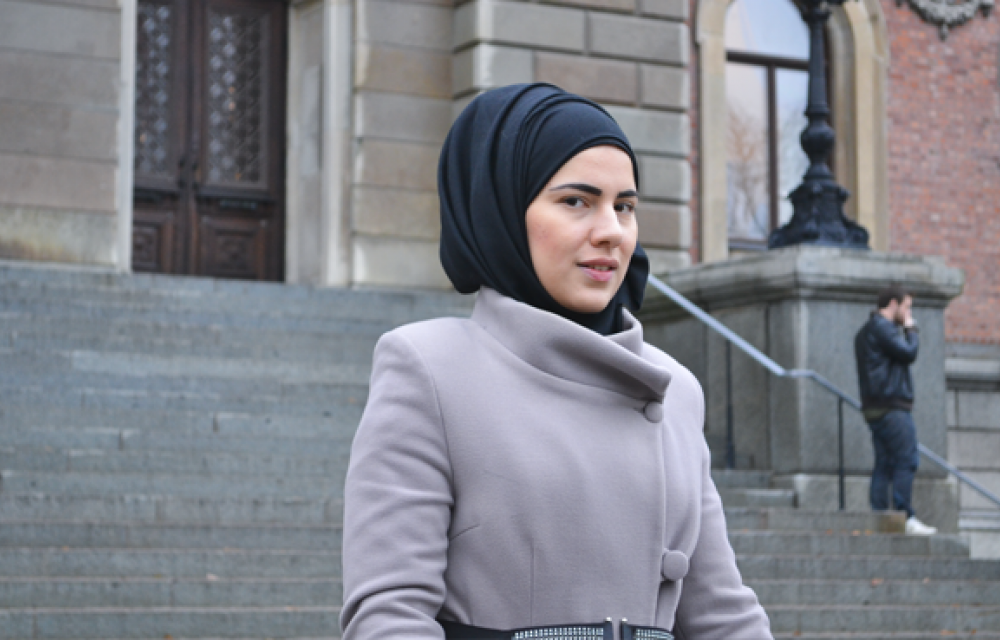
Ergo has met civil engineering student Rahma Alsaegh – one of the millions of people who have fled ISIS’ reign of terror in the Middle East and that have left behind them, not only their homes, but also their futures.
June 2014. ISIS, or Daesh, as the Arabic speaking part of the world calls them, have just taken over Iraq’s second largest city, Mosul. 21-year-old civil engineering student, Rahma Alsaegh, is on her way to take her last exam for the semester, but when she arrives on campus, she is informed that the university of Mosul is closed.
– Daesh’s men were everywhere. In the beginning I had no idea who they were or why they had taken over the university, but they banned education for women – women were supposed to stay at home, she says.
By the end of 2014, the online newspaper International Business Times reports that Daesh commanders yell at the university’s female students to cover their faces and administer punishments to those who speak with men. Hundreds of researchers are dismissed, either because they are female or because they are Shia Muslims.
At one of the Middle East’s largest academic institutions, with 30 000 students and more than 4 000 employees, the academic freedom has been well and truly restrained – Daesh close down entire departments and destroy books that they consider haram – forbidden according to their interpretation of Islam. Lectures pertaining to democracy, human rights, non-Islamic culture, and geography are cancelled and to discuss historic events that are not in accordance with their worldview is made forbidden.
Rahma Alsaegh and her family flee to Baghdad in July 2014 and one year later they arrive in Sweden and Uppsala.
***
At first, there is some confusion as to how many years Rahma, today 22 years old, has studied at university level. Our interpreter, Björn Lindgren, has mainly interpreted Egyptian Arabic before. But after a few clarifications it becomes clear that Rahma had been studying a programme in software engineering for three years at Mosul university, she had one year left.
– With a degree in software engineering you can get a job in almost any field you want to, she says.
She would like to resume her academic path here in Sweden, but that will not be possible until she is granted a residence permit. And this is a predicament she shares with many others.
Many of Sweden’s newly arrived refugees have a finished or unfinished academic degree from their homeland. According to statistics from the Swedish Council for Higher Education, UHR for short in Swedish, it is estimated that around 23 400 persons will have applied for an evaluation of a foreign education during the year 2015. That is, people that want to receive a statement regarding what their education equals in the Swedish educational system. Of these 23 400 around 10 000 have an academic education. Most of them come from Syria, Iran and Iraq.
This type of statement is not compulsory to have when applying for a job in Sweden, but it might aid employers when they are looking at an applicant’s references. Applying for a job or for an academic programme or course is not possible until you have a residence permit. However, it is possible to get your education evaluated as soon as you have applied for asylum. Usually, it takes UHR about five months to evaluate a post-secondary education.
Besides evaluating the educations of newly arrived refugees and immigrants, several other measures are taken to speed up the process of establishing those who have professional skills and experience in the labour market. For example, the Ministry of Employment recently granted Sveriges Farmaceuter (Swedish pharmacists), Almega and Svensk Handel (Swedish Trade Federation) close to 2,5 million kronor to translate course material in pharmacy to Arabic, in order speed up the process of establishing newly arrived pharmacists in the Swedish apothecary market – an area that is in dire need of new employees.
– If this initiative can shorten the way into the labour market for the approximately 600 newly arrived pharmacists, then we’ve come a long way, says Karin Meyer, CEO of Apotekarsocieteten (the Swedish Pharmaceutical Society) in a press release at the end of November.
***
But let us get back to Rahma Alsaegh. Because she is not one of the newly arrived people that have a complete university degree. Due to Daish’s entry in Mosul, she never got the chance to complete her education.
– The information that I have been given is that I will have to start over with my programme and that I might have to take tests in certain areas. But that’s all I know for the time being, she says.
For those with an incomplete record of their education, the question of validation and evaluation of their competence is a lot more complicated than for those who have a finished degree and a record of their education. The Swedish government announced on November 23 that they have given UHR the assignment to investigate the possibility of establishing an experimental operation specifically aimed at validating the education of those who have an unfinished or undocumented university or college degree.
– Today we have a big shortage of, among others, teachers and nurses. It would be a waste of resources if newly arrived people were not given the possibility of completing their education or having their finished educations validated. We simply cannot afford that, says Minister for Higher Education and Research, Helene Hellmark Knutsson, in a press release.
But exactly what this experimental operation will look like, UHR cannot say for the time being. What they do know is that it will be initiated in 2016 and completed in 2020. If newly arrived people without a finished degree want to resume their education right now, it is up to each university to individually evaluate the possibilities of admitting these people. Some people might have to complement certain parts of the courses, some might be admitted, but on the condition that they start at a lower level than they are actually at, and some might have to start over from the beginning because the syllabus differs too much from the one they had in their homeland. Regardless of on what condition a person is admitted though, he or she will need to have a residence permit before applying to any university course or programme.
At KTH – Kungliga tekniska högskolan (Royal Institute of Technology in Stockholm) – some people have attempted to bypass the issue of needing to have a residence permit in order to study at university, by allowing asylum seeking engineering students to study courses in electrotechnology without it resulting in an actual degree, but rather a letter of recommendation from the course leaders. To have asylum seekers just sit and wait, without any possibility of working or studying, is “inhumane” says one of the initiators behind the project at KTH in an interview with a Stockholm newspaper. However, the project was short-lived as the management at KTH put an end to it, stating that it was in conflict with their set of regulations.
Evidently, many attempts have been made to bypass the prevailing laws that make it nearly impossible for asylum seekers to study in Sweden. But with the largest influx of refugees since the second World War and everchanging laws pertaining how to manage this large influx, it will take time befor Sweden has a working system for establishing newly arrived people in labour market and validating their educations properly.
***
– My goal is to resume my education here; it’s impossible for me to return to Iraq.
Rahma seems very determined. Time and time again, she comes back to talking about her goals and dreams for the future. Her wish is to one day work in medicine or as an engineer. But there is also a sense of despondence in parts of her story. Even though she is very grateful that she has been given the possibility to start over in Sweden, it is wearying having to wait for your new future to begin.
– Sweden opened a door of hope for me, but it’s difficult to do anything unless you have a residence permit. I really hope that the process of getting asylum here is sped up for me and my family, or that I will be allowed to resume my education without a residence permit. I left my country and my future for a new country and a new future, and it is exhausting having to wait for the possibility to start anew, she says.
Right now, Rahma and her family is living with her eldest brother, who has lived and worked in Uppsala for around ten years. Before she and her family are granted a residence permit, they are not allowed to rent or buy a house or flat in Sweden.
Rahmas other brother, who came to Sweden together with Rama in July this year, is a doctor, specialised in ear, nose and throat diseases. But he is not allowed to intern or work here either yet.
Even though she is not allowed to resume her education in engineering, nor work, in Sweden, Rahma finds lots of stuff to occupy her during the days.
– I try to keep up with the news and new laws that concern asylum seekers in Sweden. And I spend a lot of time with my family and think about what my future has in store for me, she says.
But more than anything, she studies Swedish. Up to seven times a week.
– From the first day when I set foot in Sweden, I decided I was going to learn how to speak Swedish.
Even though she is not allowed to study Swedish at SFI, Svenska för invandrare (Swedish for Immigrants), since that requires a residence permit, there are several other organisations that offer language cafés and courses in Swedish. Rahma learns Swedish at Nyby Vision, ABF and Svenska för Alla (Swedish for Everyone).
***
Jwan Abulkarim works as a teacher at SFI, and in September this year she got the idea that she wanted to start offering proper courses in Swedish for asylum seekers and paperless refugees. And that is how Svenska för Alla was born, which Jwan Abdulkarim today runs together with Elin Österlind. The project is non-profitable and is run by grants from the Department of Education and teachers and professors who teach in their spare time.
– Right now we have 25 teachers and around 100 students in seven different groups. About 30 of them are academics. To those people we can offer courses specified on their specific trade, so that they can get a job and be integrated into the Swedish society as soon as possible, says Jwan Abdulkarim.
Apart from courses in Swedish, they also offer educational guidance in several different languages.
As a teacher at both SFI and Svenska för Alla, Jwan Abdulkarim has noticed some big differences between the two different groups she teaches.
– Those who study at Svenska för Alla are a lot more motivated when it comes to learning Swedish. Unfortunately a lot of those studying at SFI have realised that you can get by for a long time without knowing the language here in Sweden and are not as motivated to learn, she says.
At Svenska för Alla Jwan Abdulkarim gets to meet a lot of newly arrived academics who are in the same predicaments as Rahma. And she has noticed that many of them, just like Rahma, are insecure about their future prospects.
– A lot of them don’t know what’s going to happen to them. They don’t know if they will have to start over or if it’s enough to just complement their educations. It’s a long and tough process for them and many of them thinks it’s going to be easier and take less time than it actually does. I have noticed a bit of discontent with a lot of them, but their situation is not as hopeless as it might seem in the beginning.
***
Several times during the interview with Rahma, Björn Lindgren, the interpreter, barely has to translate my questions in to Arabic. At least not the simpler and more straightforward ones (“How old are you?”, “When did you arrive in Sweden?”, “What does your brother do?”). Sometimes, she even asks Björn “do you understand?” in Swedish.
Before we go our separate ways, Rahma says that she would like to add two things.
– First of all, I would like to say that I have a lot of gratitude for the Swedish state. In this country I have been able to experience security again and here I will hopefully be able to realise my dreams and I would very much like to get an opportunity to give back to this country. But that, of course, depends on whether or not I’m granted a residence permit. Secondly, I’d like to tell other people who have just arrived in Sweden that it is possible to learn Swedish. In just four months I’ve learned to read fairly well and I can speak a little bit of Swedish. It is possible.
nbsp;
Text and translation: Lina Svensk
Interpreter: Björn Lindgren


IS, ISIS, ISIL, or Daesh?
It is difficult to know what to call the now well-known Sunni Islamic terrorist sect. Swedish media has primarily used IS and English-speaking media have mostly used ISIS, but Daesh has become more and more frequently used in foreign media and is also the name that the Arabic speaking part of the world calls them. Daesh, short for al-Dawla al-islamiyya fi al-’Irag wal-Sham, literally translates to ”Islamic state of Iraq and the Levant”. It also sounds similar to the Arabic words Daes (”one who crushes something underfoot”) and Dahes (”one who sows discord”). In this article we have primarily used Daesh.
Who has to pay for their education?
A person who has been granted a permanent residence permit and who has been admitted to a Swedish university course or programme does not have to pay a tuition fee. They also have the right to apply for a loan and grant from CSN. A person with a temporary residence permit is also exempted from tuition fees, unless he or she was granted the residence permit specifically with the intention of studying in Sweden – that is, freemovers from countries outside of the EU, EEA and Switzerland. UHR have not yet been informed how to handle the question of tuition fee for those who will be granted the new type of temporary residence permits. This question is currently being handled by the Ministry of Education.
Source: UHR