


Vulkanernas ö
In the first night of a geological research expedition to Indonesia, you don’t expect to find yourself in a Bavarian themed bar served by Indonesians wearing lederhosen, listening to a band playing rock and roll cover songs. But this only served to ease us in to the experience that was to come.
A geology master student studying at Uppsala University’s Earth Science department, I had the opportunity to join renowned researchers from Uppsala, California and Rome on a month-long survey of Sumatran volcanism. The aim was to collect gas and rock samples for analysis in order to better understand volcanic hazards of the Indonesian volcanic arc. I hadn’t been to Indonesia before and didn’t know too much about Sumatra, but this was a unique opportunity I could not turn down.
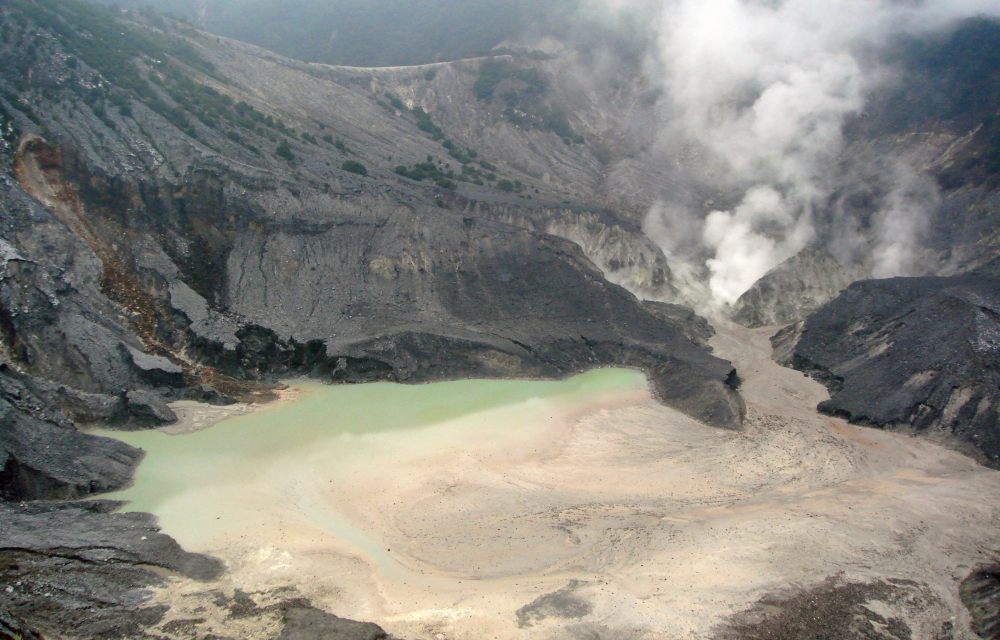
The first thing you experience when you arrive in Jakarta is the heat: it was like stepping into a sauna, and I soon realized that the majority of the trip would be spent sweating. Our first few days involved fixing paperwork on Java before we crossed the Sunda Strait to Sumatra. Once there you could feel the difference: an island with a population density ten times smaller than Java, it hosts tropical rainforest and endangered species, as well as a volcanic arc spanning its length.
Our first major trek into the jungle in search of hot springs was at Sekincau volcano. Once we had found a local guide, had the obligatory ‘how to defend against a tiger’ safety talk and double checked supplies, we began our journey. After four hours of penetrating dense jungle, our guide scything a path for us with his machete, we could see smoke billowing from the ground ahead of us – we had found the hot springs. All that was left was a river crossing. We needn’t have worried about getting wet because as soon as we made it across, the skies opened and we were treated to a downpour of biblical proportions. Once we had completed our gas sampling on the dangerously weak muddy ground we made our way back. It was soon after we began that I noticed some small black worms on the ground. I wondered what these could be, until I heard someone cry ‘leeches’ The word struck dread into me. I pulled up my trousers and saw at least ten of them attached to my legs. I quickly peeled them off with my knife only to see more crawling up my shoes. It was a nightmare journey back as I could feel them all over my legs, but eventually saw the funny side of it by the evening, once I was sure there were none left on me
Our journey continued northwards. The landscape remained very green, dotted with volcanoes. Another thing which remained the same was the food. Chilli and rice feature heavily in the Indonesian diet, something which they, and therefore we, had to eat for breakfast, lunch and dinner. After a few weeks of this my stomach slowly forgave me and I actually looked forward to the exceptionally hot sambal sauce eaten with every meal.
One night during dinner at the coastal town of Padang, I felt myself wobbling in my chair. I initially put this down to having eaten something I shouldn’t, when lizards started falling from the ceiling. It took us a few minutes to realize we had just experienced an earthquake. When we got back to the hotel we found out that it was the 7.8 magnitude earthquake which caused a fatal tsunami on the Mentawai islands.
The geology of the island is stunning. This becomes more apparent as we reach Lake Toba – a crater lake formed 75000 years ago when Toba erupted, an event so large, it nearly wiped out the human race. Our first sight of this huge lake occurred as we turned a corner after a long drive and were greeted with stunning views of the steep sided caldera walls and water stretching off into the distance: a glorious sight. When you see the size of the lake (100 km by 30 km) you realise that it must have been an incredible eruption to have created this immense crater.
After 26 days, 15 volcanoes, hundreds of insect bites and too many chillies, we made it home. Sumatra is a unique destination and one not yet fully developed for tourists. Whilst we were there, Indonesia experienced a deadly volcanic eruption, an earthquake and a tsunami. It is clear that in order to be such a geologic masterpiece, it must all come at a dangerous price.
nbsp;